

When Adults Confuse Children

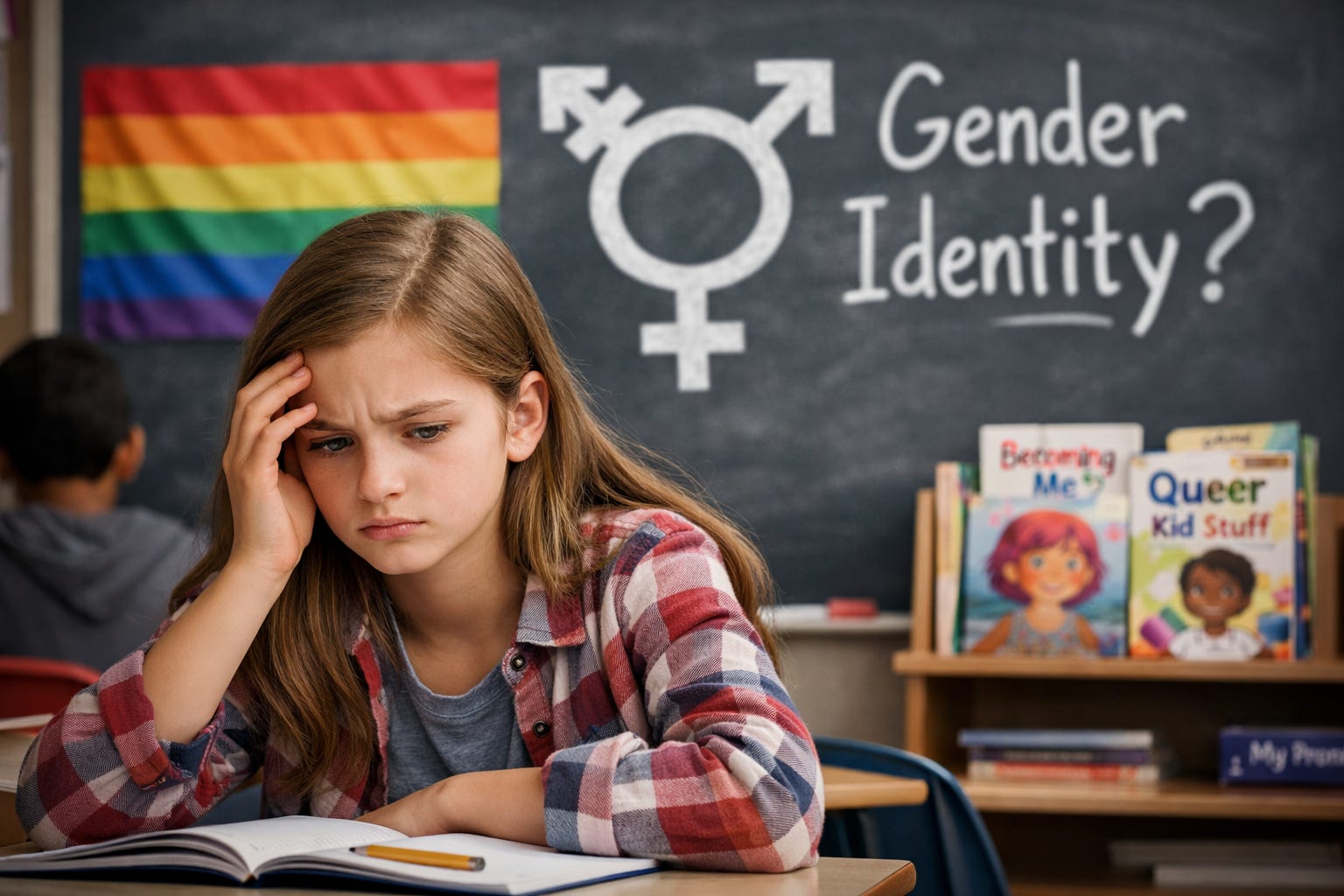
Something has been happening in American schools that many parents are only finally beginning to realize, and once you see it, you can’t unsee it.
Children who are still learning who they are are being introduced to complex ideas about gender and sexuality long before they are emotionally equipped to process them. What once would have been considered deeply personal conversations reserved for families are now appearing in classrooms, lesson plans, and school libraries.
And many parents are asking the same question.
Why?
For those of us who grew up in a different time, the shift is jarring.
When I was young, around ten or eleven years old, I was what people would call a tomboy. I climbed trees, played sports, wore oversized sweatshirts, and had little interest in makeup or fashion. I was more comfortable running around outside than doing anything that resembled what people thought girls were “supposed” to do.
And like millions of other girls, I eventually grew out of it.
Not because anyone tried to correct me. Not because an adult stepped in to guide my identity. It simply happened as I matured and began to understand myself better.
That process is normal.
Childhood is a time of experimentation, uncertainty, and discovery. Kids try on identities the way they try on hobbies or interests. One year they are obsessed with dinosaurs, the next they want to be rock stars or astronauts. They grow, they change, they figure themselves out over time.
But what concerns many parents today is that this natural period of exploration is increasingly being met not with patience, but with ideology.
Instead of allowing children to grow into themselves, some schools appear to be encouraging them to interpret normal childhood uncertainty through the lens of gender identity and sexuality. For a child who already feels unsure, which is most children at some point, introducing adult frameworks around identity can create more confusion, not less.
When I was growing up, my teachers were simply teachers.
They taught reading, writing, history, and science. They challenged us intellectually and pushed us to learn.
What they did not do was introduce themselves through the lens of their personal lives.
I didn’t know if my teachers were single or married. I didn’t know their political beliefs. And I certainly didn’t know anything about their sexual preferences. Not because those things were shameful, but because they were irrelevant to the job of educating children.
Today, many parents feel that boundary is disappearing.
The classroom, once a place focused on learning, is increasingly becoming a place where adult cultural debates are introduced to children who neither asked for them nor need to carry them.
The result is that conversations that once belonged within families, guided by parents who know their children best, are now being introduced institutionally, often without transparency or parental involvement.
That’s not tolerance. In fact, what we are increasingly seeing is a strange performance of tolerance. People parade themselves as enlightened and accepting, but in doing so they often ignore something fundamental about children, that kids are still developing, still experimenting, still trying to understand the world and themselves.
Real tolerance would mean allowing children the space to grow without rushing to define them. It would mean recognizing that confusion during adolescence is normal, not something that needs to be immediately categorized or affirmed by adults eager to demonstrate how progressive they are.
Instead, what we often see is the opposite. Adults projecting complex ideological frameworks onto young minds that are still forming, then congratulating themselves for being compassionate while dismissing any parent who raises concerns.
It’s ignorance dressed up as virtue.
Children deserve better than to become symbols in adult debates about identity. They deserve patience, humility, and the understanding that childhood is supposed to be a time of discovery, not a time when adults rush to place labels on them.
What they don’t deserve is to become participants in ideological battles they are too young to understand. Let kids be kids. Let them grow. Let them figure themselves out in their own time.
And remember that education should prepare children for the world, not recruit them into cultural conflicts that adults themselves are still struggling to resolve.
What a great article, and, so very true! It also begs the question, when and how did things change? I know there are many good and noble teachers out there, with good virtues and a genuine desire to teach children and not inject their political opinions upon them.
So where did things go wrong? I believe indoctrination begins at the higher learning institutions that teach our teachers; molding and shaping future educators to carry the Marxist/Communist/Socialist agenda by replacing the process of learning with partisan or sectarian opinion.
Bravo DOR